


How to Professionally Self-Publish Your Novel

Hello everyone, this tip I have for you here can also be found in video form on my YouTube channel, Nagy in the Margins. Feel free to learn wherever is best for you!
THE TRUTH ABOUT SELF-PUBLISHING is that there is a ton of work in order to get your novel perfected for your reader, from cover, to layout, to the story itself. Because of that, I have made a checklist of everything you must do to get your story to best shape it can be!
SELF-PUBLISHING CHECKLIST:
Self-Editing
The first item of the checklist is making sure you have perfected the story and the writing of your novel to your maximum capacity, a.k.a. “self-editing”. You’ll make two, three, four or more drafts before saying it is ready for the readers.
I like to follow rules of three. If this is your first time writing, I highly recommend you go through at least 3 drafts: the first, to get the idea out of your head, to make it real; the second, to perfect the idea, work on the characters, settings, plot; the third, to perfect the writing and punctual tropes and themes (if your character had major changes from the first to the second draft, for example, the third draft is where you’ll check if it is consistent and there are no plot holes or character arc holes)
This will guarantee that the story is at its best from your POV. Of course, we, authors, usually have that common problem where the manuscript is never good enough. If that’s your case after the third draft, you have two paths to follow: either make a fourth draft, addressing the issues you’ve seen in the third, then moving on to the next item of our list, or simply move to the next item right away.

Beta Readers
Beta readers are there to be your first separate set of eyes after you finish your self-edits. There are some who argue Developmental Editors (such as myself) should come before the beta readers; however, for me, beta readers are a natural continuity of your self-edits, and the Dev. Editors are there as the professionals who will catch what you and others couldn't catch.
That being said, beta readers are there to check if there are any inconsistencies, plot holes, grammar issues, weird phrases or facts, how your character is being perceived... They'll basically provide you with a general opinion of your story, with remarks on specific things if you ask them.
There’s this video of Nat, an author I met on TikTok, that is perfect if you are in the beta-reading stage. She made a list of questions you can ask your beta readers to get the most out of their help. You can check her video here.
You might see people charging for beta reading services, and while that is an option, I truly believe beta reading should be a community-driven, free exchange. Why? Because beta readers aren't professionals—they are your target audience. They are providing the 'reader's reaction,' not an expert's 'fix.' Most writers work on a 'swap' basis: I read yours, you read mine. This builds a support system. If you start paying for every set of eyes this early on, you’ll burn through your budget very, very quickly, so when you need it the most (be it professional editors, cover artists, or pure marketing), you won't have as much as you could've.
Finding an editor
In order to find the editor you need for the stage your story is at, there are some questions you can ask yourself: Am I happy with the story? Do I still have plot issues I can’t solve? If yes, you start with Developmental Editing.
If you’re confident in the story but your writing is feeling off, then you move to Copy Editing. And once that’s done, you finish with a Proofread for those final minor errors.
Every editor might use slightly different names for these—some might split 'Line Editing' into its own category, for example. I'll use my specific denominations, though. For instance, I include 'Line Editing' within my Copy Editing service because I believe polishing your writing skills should happen at the line level.

Developmental editing
I always recommend first-time authors get Developmental Editing, because this is your first story, and while the betas will help you check the errors and issues with it, the developmental editor will also provide you with solutions and tools that you can take with you for life to improve all your novels, so it is a price very much worth paying for.
In this type of editing, we are focusing on your story, which means the plot structure, the character arcs, the overall pacing, chapters’ position, the magic logic, if the ending is satisfying even if it is a sad one… Anything that constitutes the essence of your story.
Developmental editing is when we, editors, go on a deep focus. I, usually, read your novel at least twice, so I can have my first-time-reader reaction and then have a deeper analysis once I know everything. Because of this, this is the most intensive type of editing and it can range from one to three months of work. I’ll always be available to you in the meantime, even though I won’t reach out to you much, you can always feel free to reach out to me and ask how things are going. In the end, I’ll give back to you your manuscript with all the comments I made throughout the story (including my real-life reactions, usually in the form of memes 😅), plus an editorial letter, where I’ll explain in detail your points of improvement, with tools on how you can improve them, and my general opinion of your novel.
Due to all of the work involved, it is also the most expensive type of editing. Right now, 2026, my rates are on the lower end of the EFA (Editorial Freelancers Association), which is the industry standard for professional US-based editing rates. For Developmental Editing, I charge $0.03 per word, which means that for a standard 100k word novel, this would be around $3,000.00.
If this is too much for you, but you’d still like to have a developmental edit to be done, don’t worry. Most editors usually offer manuscript assessments too!
Manuscript Assessments
They are a cheaper version of the developmental edit. We’ll go through your manuscript once, and write just the editorial letter, so you’ll have a general overview of your strengths and weaknesses. However, because this is a general overview, we won’t be able to help you with specific parts of your novel, nor will you get specific comments inside the manuscript.
Copy Editing
During a copy edit, I’ll be looking at the line level, focusing on how we can improve each phrase, each sentence, each paragraph, each dialogue on its own. I’ll be on the lookout for repetitive words, awkward phrasing, factual inconsistencies, spelling inconsistencies, page layout, and flag+fix them all for you.
I won’t check if the character is likeable or not, if the plot has holes in it or not, if the theme is coherent throughout the whole story, but if it is too big of an issue, I might just leave a comment there for you to know that issue exists.
On copy editing, I’ll be focusing on making your writing feel intentional, professional, and concise.
Proofreading
This is the final stage of the edits, where you’ll get the final polish that will make your story shine. Think of it as a magnifying glass where we’ll be taking an overall look of the text, trying to catch those errors that always slip by, like typos, missing punctuation, weird double spaces, a sudden, unplanned change in the font...
Warning: Never skip proofreading because you 'think' your copyedit was perfect. Readers will find that one typo on page 102, that punctuation missing on page 190, that weird layout on chapter 20, and though a single issue may not change your reader’s perspective, an accumulation of them it can make your reviews drop.
Book Formatting & Cover
Specially if you're looking into self-publishing a physical book, book formatting is a must. It will allow your story to go from a simple document to a real, stylish book. You don't need to have a very fancy layout, with pictures and whatnot, but you must make sure that the headers and footers are like what you see in other books (pages at the footers are the bare minimum), that the chapter pages do not have any headers and always start on the odd-numbered pages (though there are exceptions for this one), and that you have the front matter and back matter of the book aligned. You must check if the font is consistent throughout the pages, if the chapter titles' font is also consistent, is the spacing is consistent etc.
It is a lot of work and you can do it all by yourself, as I've seen plenty of people do; however, the easier path is to hire a book formatter. Here you can even hire a book formatter before proofreading, and thus the proofreader can help you finding things the book formatter let it slide for any reason, but beware that not all proofreaders check for layout.
Meanwhile, you can also hire a cover artist (or make the cover yourself if you have the skills). The cover is very important, and if you want the same cover to be used for both digital and physical formats of your book, you must have one that can be draw attention both in a bookstore and in the tiny screen of a cellphone. The cover will be that first impression your reader will have about your book, even more so in the digital world, so you got to have something that will make them choose your book in the midst of all the others.
Remember to make your cover coherent with your genre, too. You don't want a reader picking up your book thinking it is a very fluffy and flourishing romance only for them to start reading and see it is actually a R rated extreme horror story.
ARC Readers & ISBN
Once your book is all pretty and ready for the world, you'll search for our beloved ARC readers.
ARC readers are, simply put, Advanced Reader Copy readers. They are the ones that will see your book for the first time, for free, and leave out your first reviews when the book is available online in the platforms of your choice.
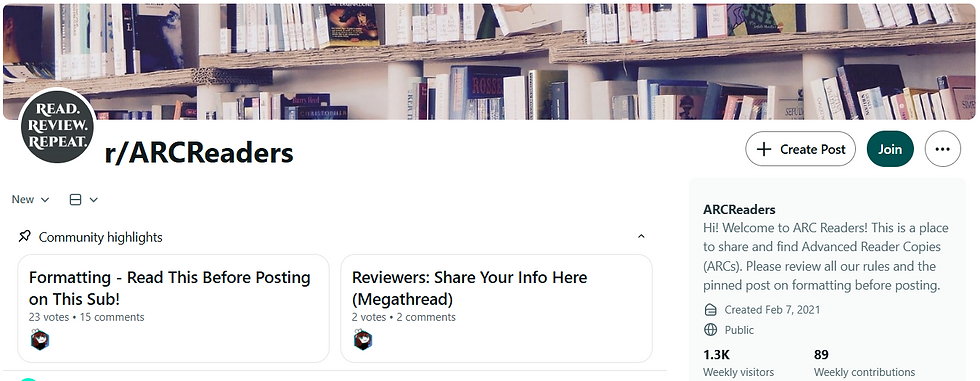
There are many places where you can get ARC readers: paid sites like BookSprout, BookSirens, NetGalley, and StoryOrigin, and you must be careful because some websites are better for certain genres while others are not. A fact that I know of is that BookSirens is a must-go to romance authors, and some fantasy (if you’re writing fantasy and not romantasy, then maybe you could try other websites). But you also can get free options! Reddit is my favorite, as you have subs dedicated for ARC readers, such as r/ARCreaders – not to be mistaken by ArcRaiders – and you can always rely on social media, too. I know there are some facebook groups that are for finding ARC readers, Goodreads also has some, and TikTok and Instagram, depending on your genre and followers, can also be a good place to post you’re on the lookout for ARC readers.
The only issue with the free ARCs is that you’ll be responsible for the email list and sending out the copies. I highly recommend you keep it all digital, as sending physical copies can get pretty expensive, specially if this is your first novel. There is an article April Aberdeen has written and that I thought it was super helpful on the step-by-step of setting your ARC campaign. Check it out if you are on that stage!
While your book is out there for the ARC readers, it is time to set up your ISBNs and book pages on the platforms of your choosing. Be it Amazon, Ingram Spark, Barnes and Noble, or any other, you can, of course, set them up as soon as you begin to write your book--and I think this is very common practice--but just to make our article here more concise, I’ve decided to let this as the last steps 😅
I recommend you go after your own ISBNs (which stands for International Standard Book Number), and not relying on the free ones you can get out there, like the ones from Amazon. If you are making the book in different formats, you must get one ISBN for each format (one for ebook, one for paperback, and one for hardcover). Each country has their own place to get their ISBNs: USA has Bowker, UK and Ireland has Nielsen Book Data, Netherlands has Mijn ISBN, Brazil has Câmara Brasileira do Livro, and so on. When getting your ISBNs, you must check what is your country’s agency to do so.
Why should you get your own ISBN? Because that way you’ll have more control over your book. When you use a 'free' ISBN from a platform like Amazon, they are listed as the 'imprint' or publisher of record. By buying your own, you are the publisher. This gives you total control over your metadata, makes it much easier to get your book into physical bookstores and libraries, and ensures that if you ever decide to move your book to a different platform, the sales data and 'identity' of that edition move with you.
Just be careful if you’ll publish it in more than one platform. If you intend to do so, say, publishing both on Amazon and Ingram Spark, you must use your own ISBN on both, so that the linking takes to the same thing, but upload to Ingram Spark first. If you publish on Amazon first, Ingram Spark might reject your ISBN because it’s already 'in use.' Upload to Ingram first, get it approved, and then publish it on Amazon. It saves you a massive administrative headache later.
Publishing
Finally, after you set everything up, you can hit that “publish” button on all the platforms you've chosen to publish! Check if everything is in accordance to each platform's guideline, preview how the book will look like in any format you chose to publish, order your author copies if you can to check if the printing is working well, then set a date and publish!
You can do pre-orders first or letting it out for the world to see right away, the choice is yours to make, and you must consider all the marketing around it depending on your choice. Look out tips online on marketing strategies if you want bigger sales, or, if you're writing and publishing just for fun, then do it all on your own time and, well, have fun!
If you’re feeling overwhelmed by all of these steps, don't worry. It is a lot for a first time, but remember that publishing a book, one that you put your heart and soul in, is not a sprint, it is a marathon. Going indie means you control your timeline, your schedule, so you don’t have to worry that much about postponing your ideal publishing date. It is much better to go slow and steady, following each step with peace of mind, than to rush everything just to publish fast and getting a bad job done because of it. If you want good reviews, you must put time and effort into it.
It’s also worth remembering that even the biggest names in traditional publishing don't do this alone. When you see a bestseller in a bookstore, that book has been through a developmental editor, a copy editor, a proofreader, a book formatter, a cover artist, as well as ARC readers provided by the publisher. The only difference is that as an indie author, you are the CEO. You get to hand-pick the experts who best understand your voice and your vision, rather than having a team assigned to you. You're not doing 'extra' work; you're just taking the wheel in the same professional process the pros use.
Now, after all I’ve said, let’s take a deep breath to process everything.
Let’s bring it back to your story. Open your manuscript. Skim through it, think of the story you’ve created. What do you feel is missing right now? What is the biggest challenge you’re facing in your draft? If you want a professional to help you with the editing stages, hi there! I’m a professional editor, afterall haha
Good luck and stay strong on this massive journey 😊


Comentários